Vessel Technology

All things tech!

Hello to the Little Red Daemon

By Dermot Tynan • March 20, 2013

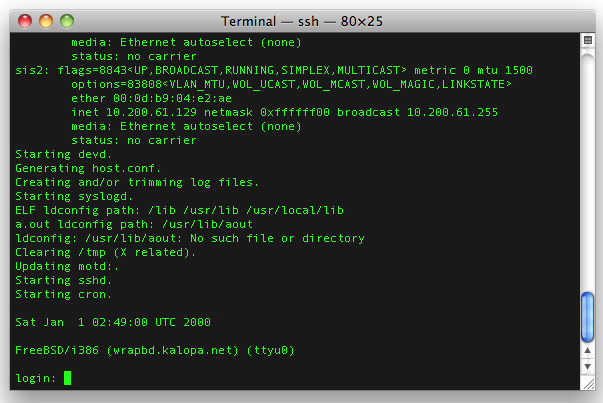
After much tweaking and hacking with configuration files and kernel build options, I finally have a FreeBSD 8.3-RELEASE kernel and install running on a Wrap board. Technically, it's NanoBSD, which is a scaled-down FreeBSD install, which boots from Compact Flash. The WRAP board is the PC Engines forerunner to the ALIX. When National Semiconductor and AMD stopped making Geode chips, the guys at PC Engines had to stop making their very popular WRAP board. I still have a few of them tucked away, for emergencies such as this.
The hull starts to take shape.

By Dermot Tynan • April 1, 2013

On Henry's advice, the round hull of earlier designs has been discarded in favour of a hard-chined hull. We were originally planning a fibreglass hull from a round mould. The complexities of first producing a "plug" and preparing a mould from the plug, not to mention having to then fibreglass the hull itself, are quite involved. Henry suggested hard chines an 6mm marine ply for the construction, and a light bulb lit up.

Cutting out the Bulkheads.

By Dermot Tynan • April 14, 2013

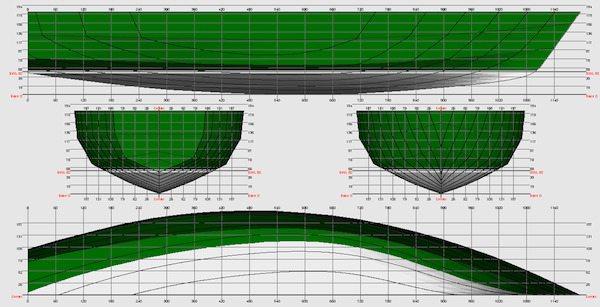
A slight change from the version of the hull from The hull starts to take shape.; the hull height from the base of the hull to the deck (not including the keel) was 180mm. As I started to look at cutting bulkheads and the transom, it struck me that the hull is quite shallow. It looks fine from DelftSHIP but that's a low freeboard.

The beam of the boat is around 360mm, which is twice that depth. The original intent was to create a hull which wasn't too "beam-y" but that's a 2:1 aspect ratio. I decided to increase the hull height by 50%. Luckily, DelftSHIP will scale your drawing in any or all of the three vertices. So, five minutes later, and we have a new hull with a 270mm depth.

The keel is attached.

By Dermot Tynan • April 20, 2013

After much sanding and polishing of the keelson, and the frames for the hatches and top deck, the hull is starting to take shape.

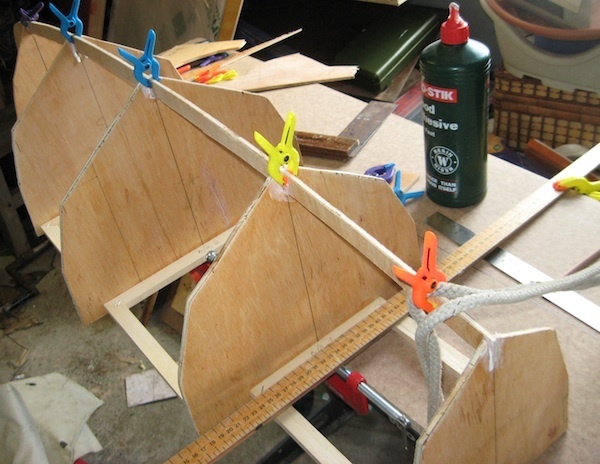
The bulkheads are cut from 6mm exterior grade plywood. The wood which resembles a picture frame is pine, and it is used to hold the bulkheads and transom into a square position, and to provide additional strength to the hull. Eventually those frames will be covered over by 6mm ply on the deck.

Hull 001 is almost ready for fibreglass

By Dermot Tynan • May 3, 2013

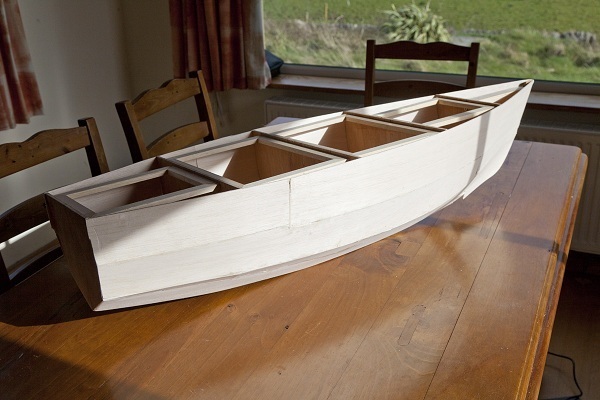
After applying 3/32" balsa wood to the bulkheads and transom, the hull is starting to look like a real boat!

You can clearly see the deck support frames now. They are 6mm below the sheer line, to allow for 6mm exterior (or marine) ply deck pieces. But first, the balsa needs to be sanded and patched a bit. Also, the 3 or 4 layers of chopped strand matt need to be applied. When it is finished, the balsa wood will be completely enclosed in fibreglass. This is a standard "sandwich" construction. The balsa adds a layer of strength (believe it or not!) to the two layers of glass either side. It is similar to the central section of an I-beam or girder in that it separates the two outer layers and means that the bend radius is increased. Or at least, that's my understanding of it...